
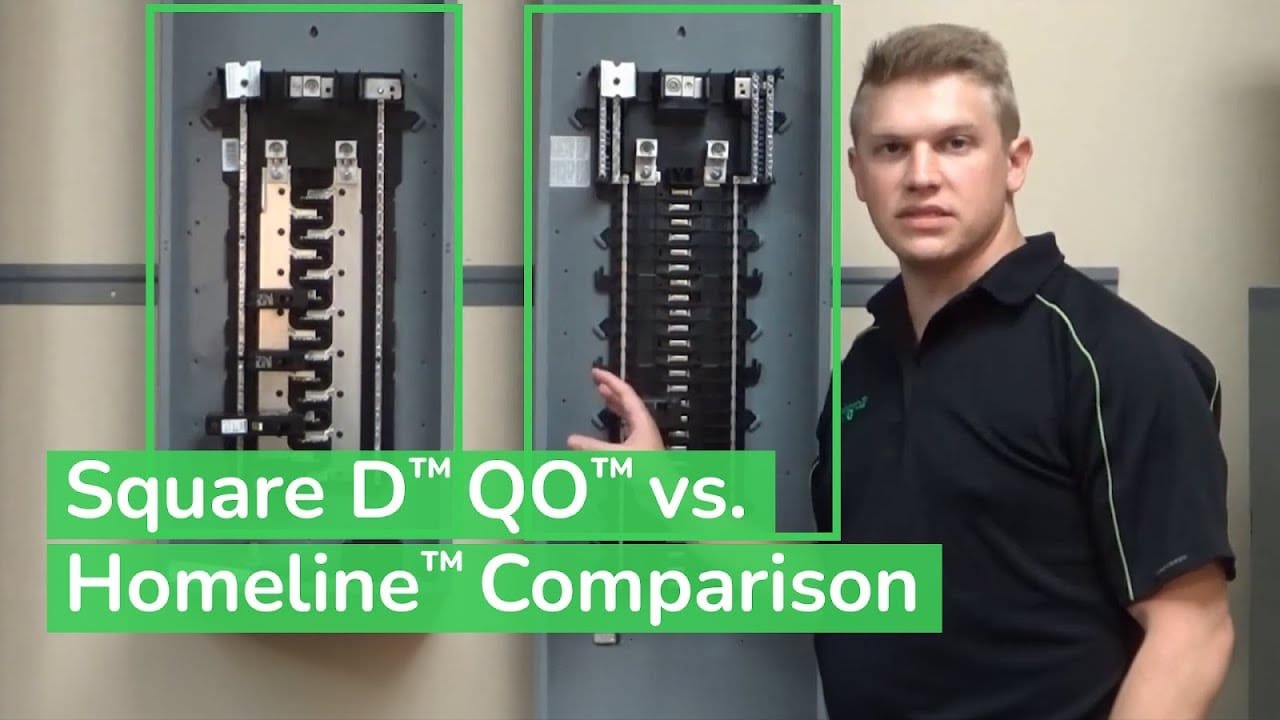
Square D QO vs Homeline: How Many Breakers Can Be Installed in a 4 Circuit Panel for Backup Generator Inlets
Ever found yourself staring at an open subpanel during a midnight power outage, flashlight clamped between your teeth, wondering why your essential circuits won't fire up? I have. More times than I care to admit over my fifteen years as an electrician. When storm season hits, setting up a transfer setup or a dedicated subpanel becomes top priority, and that brings us straight to one of the most common matchups in residential power: Square D QO vs Homeline: How Many Breakers Can Be Installed in a 4 Circuit Panel for Backup Generator Inlets.
Look—it sounds like a simple math problem on paper. You have a 4-space panel, so you get four circuits, right? Well, not so fast. Electricians know that panel spaces, circuits, and physical breaker slots do not always share a simple one-to-one relationship, especially when you factor in double-pole breakers for a 240V backup generator inlet. Throw tandem breakers, CTL (Circuit Total Limiting) rules, and bus bar notch designs into the mix, and things get confusing fast.
If you choose the wrong panel family or misread the labeling inside the deadfront, you might end up with an unsafe installation that fails inspection. Or worse, you will be stuck in the dark when your generator fails to feed your critical home circuits. Let's break down how Square D QO and Homeline subpanels handle circuit density for emergency generator power.
Honestly? Getting this right saves you money, headache, and potential electrical fires.
Understanding Small Enclosures and Electrical Codes
Space Constraints in 4-Circuit Panels
When dealing with a compact transfer subpanel, space is at a premium. A standard 4 circuit panel for backup generator inlets usually comes in a small NEMA 1 indoor or NEMA 3R outdoor enclosure. But here is where homeowners get tripped up: a panel advertised as a "4-space" enclosure might only fit two double-pole breakers, which instantly fills the entire physical bus structure.
A standard 240-volt generator inlet box requires a double-pole breaker to accept both hot legs (L1 and L2) from your generator. That single generator inlet breaker immediately takes up two physical pole spaces on your panel's bus bar. If your panel only holds four single-pole spaces total, half of your physical real estate is gone before you even connect a single household branch circuit.
That leaves you with just two remaining pole spaces for critical loads like your refrigerator, well pump, furnace blower, or lighting circuits. Depending on whether you need 120V or 240V for those essential branch circuits, your options shrink rapidly. This is why understanding physical panel layout before mounting hardware on your siding is so vital.
Seriously, never buy an emergency panel based purely on the number on the front of the box without reading the wiring diagram inside. The fine print matters.
Tandem Breakers and Panel Ratings
Can you just slap tandem breakers inside to double your circuit count? That depends entirely on whether you are using a Square D QO subpanel or a Square D Homeline subpanel, alongside the specific model number of the enclosure. A tandem breaker, often called a "piggyback" or "twin" breaker, allows two independent single-pole circuits to occupy a single physical space on the bus bar.
However, the National Electrical Code (NEC) demands that equipment must be installed according to its listing and labeling. If the panel label states "4 Spaces / 4 Circuits," it is physically or structurally designed to reject tandem breakers. If the label says "4 Spaces / 8 Circuits," the manufacturer has integrated slots or bus configurations that legally accept tandems.
Using tandems in a panel not rated for them is a major code violation. Inspectors spot this in seconds, and modding a breaker by grinding off rejection clips is a recipe for catastrophic failure. Trust me, I have seen melted bus bars caused by forced breaker modifications, and it is never pretty.
Understanding this distinction is the core of evaluating Square D QO vs Homeline breaker capacity when planning a portable generator hookup for emergency resilience.
Comparing Square D QO and Homeline Architecture
The QO Design Advantage
The Square D QO series has been the gold standard for premium residential and commercial electrical systems for decades. You can instantly spot them by their compact 3/4-inch breaker width per pole and the iconic red "Visi-Trip" indicator that pops up when a breaker trips. But beyond aesthetics, QO bus architecture handles breaker mounting very differently than standard residential panels.
In small QO enclosures rated for backup generator transfer duties, Square D offers specialized QO tandem breakers (QOT series) that feature a mounting cam. In QO panels designed to accept tandems, the neutral/mounting rail has specific slots cut into it. This allows a QOT tandem to snap directly onto a single 3/4-inch space, providing two 120V circuits in the space where competitors only fit one.
What does this mean for your 4 space generator transfer panel? In a QO panel rated as 4-space / 8-circuit (such as select QO small load centers):
- You can install one double-pole 30A or 50A Square D QO generator breaker across 2 physical spaces.
- You can then fill the remaining 2 physical spaces with two QO tandem breakers.
- This configuration yields 1 double-pole generator inlet circuit plus 4 individual 120V branch circuits for emergency loads.
- If you use quad-style or double-pole tandems where supported, circuit density increases even further within strict code compliance.
It is an amazingly compact setup. The tight 3/4-inch format lets you pack serious utility into a tiny steel enclosure mounted right next to your main service panel.
Homeline Mechanics and Physical Limits
Now let's talk about Square D Homeline panels. Homeline is Schneider Electric's budget-friendly, industry-standard residential line. It utilizes standard 1-inch width breaker slots per pole. Because Homeline breakers are wider than QO breakers, the overall footprint of a Homeline enclosure is noticeably larger for the same circuit count.
In a typical 4-space Square D Homeline generator subpanel, physical space limitations are stricter. Homeline tandem breakers (HOMT series) require specific notched bus bars to seat properly. If your 4-space Homeline panel is rated "4 Spaces / 4 Circuits max," the bus bar lacks those notches entirely. You are strictly limited to standard 1-inch breakers.
In a strict 4-space / 4-circuit Homeline load center setup:
- The 240V generator inlet breaker takes 2 spaces (2 inches of bus bar).
- You only have 2 single-pole spaces remaining for house loads.
- You can run two 120V single-pole circuits (like a fridge and furnace) OR one additional 240V double-pole circuit (like a well pump).
- You cannot legally install HOMT tandem breakers if the panel lacks tandem bus notches.
However, if you purchase a Homeline panel specifically designated as a 4-space / 8-circuit model, the bus bar will feature tandem notches. This allows you to install Homeline tandem breakers in the non-generator slots, bumping your total usable single-pole circuits up to four alongside your double-pole generator breaker.
It really boils down to checking the exact model suffix. A single letter in the part number determines whether you are stuck with two branch circuits or four.
Calculating Generator Inlet Breaker Capacities
Dedicated Breakers vs Generator Interlocks
When feeding a subpanel from a portable generator inlet box (like an L14-30 or SS2-50 inlet), safety requires that the generator power and utility power can NEVER be energized at the same time. Backfeeding grid lines will kill utility workers repairing lines down the street. It is as simple and as serious as that.
To safely install a generator inlet breaker in a 4 circuit panel, you must use a mechanical mechanical interlock kit or a specialized transfer enclosure. A mechanical interlock is a sliding metal plate that physically prevents the main utility breaker and the generator input breaker from being turned on simultaneously.
In a small 4-circuit panel used as a manual transfer panel, the generator inlet breaker acts as the main disconnect for the generator source. Here is how the physical breakdown works in practice:
- Utility Main / Feed Breaker: Takes 2 pole spaces (if feeding from the main panel during grid operation).
- Generator Inlet Breaker: Takes 2 pole spaces (connected to your outdoor inlet receptacle).
- Interlock Mechanism: Slides between the two main double-pole breakers.
Notice something crucial here? If both your utility feed breaker and your generator inlet breaker take up 2 physical spaces each in a standard 4-space panel, you have used all 4 physical spaces just for the transfer interlock mechanism! In this specific mechanical configuration, zero spaces remain for branch circuits unless the panel accepts tandem or quad breakers.
Look—this is why many pros skip 4-space panels for interlock setups and jump straight to 6-space or 8-space panels, or use panels specifically engineered with built-in switching controls.
Real-World Circuit Layouts for Emergency Power
Let's walk through what you can actually power in a real home using a Square D 4 circuit panel with generator inlet. Suppose you purchase a model that allows tandem breakers (an 8-circuit maximum rating).
For a typical 7,500-watt portable generator, your panel arrangement usually looks like this:
- Spaces 1 & 3 (Double Pole 30A Breaker): Incoming power feed from the outdoor NEMA L14-30 generator inlet box.
- Space 2 (Tandem 15A/15A Breaker): Circuit A powers your refrigerator; Circuit B powers your gas furnace blower or heat controller.
- Space 4 (Tandem 15A/20A Breaker): Circuit C powers kitchen counter outlets/Wi-Fi router; Circuit D powers living room lighting and sump pump.
Under this optimal configuration using a Square D QO 4 space 8 circuit subpanel, you are running 1 generator inlet feed plus 4 essential household branch circuits. Everything stays clean, legal, and safely within thermal limits of the panel structure.
If you tried the exact same installation with a basic 4-space / 4-circuit Homeline non-tandem panel, you would be forced to pick only TWO 120V branch circuits total. That means choosing between keeping your food cold or keeping your furnace running. Not a fun choice when it is sub-zero outside.
Always verify your generator output capacity (amps/watts) against your breaker sizing. A 30-amp inlet needs a 30A double-pole breaker and 10 AWG wire. A 50-amp inlet demands a 50A double-pole breaker matched with 6 AWG copper wire.
Common Questions About Square D QO vs Homeline Generator Panels
How many breakers can I physically fit in a Square D QO 4-space panel for a generator inlet?
In a standard 4-space QO panel that supports tandem breakers (rated 4-space / 8-circuit), you can install one double-pole breaker (2 spaces) for the 240V generator inlet and up to two QO tandem breakers in the remaining 2 spaces. This allows for 1 generator inlet connection and 4 individual 120V branch circuits, totaling 3 breaker bodies and 5 distinct circuits.
Can I use Homeline tandem breakers in any 4-space Homeline panel?
No. You can only use Homeline tandem breakers (HOMT) in Homeline panels that have notched bus bars designed for them, designated as "4-space / 8-circuit" enclosures. If your panel is labeled "4-space / 4-circuit," inserting tandem breakers is prevented by physical rejection features and violates NEC electrical codes.
What is the difference between QO and Homeline breaker physical sizes?
Square D QO breakers are 3/4-inch wide per pole, making them more compact. Square D Homeline breakers are standard 1-inch wide per pole. Because of this width difference, QO and Homeline breakers are not physically interchangeable and cannot be installed in each other's load centers.
Do I need a double-pole breaker for a 120V/240V backup generator inlet?
Yes. Standard generator inlets (such as 30-amp L14-30 or 50-amp SS2-50) supply two 120-volt hot legs to create 240V power across the bus bar. Connecting the inlet requires a 2-pole (double-pole) breaker that spans across both hot bus bars in the subpanel to balance the load properly.